
Green technology
ECOLOGY = ECONOMY
ALEMO Foam Extrusion
Unlike traditional extrusion lines, which harm our planet due to excessive CO₂ emissions, for every kilogram of foam produced using ALEMO foam sheet extrusion lines, 1 kilogram of CO₂ is kept out of the atmosphere, protecting our planet for future generations.
ALEMO designs and develops machinery based on the production process, not the other way around, thereby achieving high uniformity in foam thickness across the entire width.
The result is a reduction in CO₂ emissions for the planet and significant savings for the manufacturer. This is where ecology and economy come together.
With ALEMO’s industry-leading twin-screw extruders, customers can achieve up to a 25% reduction in raw material consumption, reduced waste, and a significant reduction in energy consumption of up to 40% compared to tandem extruders (energy consumption of less than 0.3 kWh per kg of extruded material). It is also possible to produce EPE and EPP foam on the same extruder.
ALEMO machines are sturdy and reliable, designed to operate at peak performance for many years. The first ALEMO EXT120 foam extrusion line has been in operation since 2008 at full production capacity.
This is ALEMO Foam Machinery. Every 1 kg of foam means 1 kg less CO₂ for the planet.
The ALEMO extrusion line is designed to be Industry 5.0-ready and enhanced with an AI-powered operator assistant—currently under development—that will help optimize production, minimize waste, and further reduce CO₂ emissions through smarter process control.

How ALEMO is redefining sustainable bubble wrap production
Following ALEMO’s presentation “Ecology = Economy,” in which we highlighted how the future of sustainable foam extrusion lies in designing machinery tailored to the production process, and the insights shared by Andrea Sirk (CEO of ALEMO) in the podcast “How Innovation Beats Cost Pressure,” we are proud to present another success story in innovation.
👉 A solution patented by ALEMO (invented by Dr. Andrea Sirk) that is shaping the future of sustainable bubble wrap bag production in a single step starting from PE pellets.

HOW INNOVATION OVERCOMES COST PRESSURE: Insights from Andrea Sirk (CEO, ALEMO)
In a recent episode of Matteo Valléro’s Challenge Podcast, Andrea Sirk, CEO of ALEMO – Foam Machinery producer, shared a clear and practical perspective on how industrial companies can navigate today’s increasingly complex environment.
The challenges facing the manufacturing sector in 2026 are real and steadily growing.
Rising steel prices, increasing energy costs, hidden taxes embedded in every meter of production, and the growing scarcity of foaming gases due to environmental regulations are putting the entire industry under pressure.
But, as Andrea points out, the real challenge is no longer just productivity.
It is not about how much you produce per hour, but how efficiently you produce it.

We supply market leaders around the world
ALEMO has developed and manufactured more than 130 extrusion lines and other conversion machines for the production of expanded polyethylene, polypropylene, and polystyrene. Since 2007, we have supplied foam extrusion lines and other machinery to market leaders in nearly every part of the world: Europe, North America, Latin America, Australia, India, Russia, Japan, and Central Asia.
COMMITMENT TO EXCELLENCE
ALEMO has an in-house research and development team. In addition, we collaborate with external partners and institutions. We are constantly seeking technical solutions to build better machinery. Our goal is to increase productivity while also striving to achieve higher and more consistent product quality. Furthermore, we focus on reducing waste, making equipment easier to use, and lowering energy consumptio
Our philosophy is to install top-quality components and use the finest materials. This approach enables us to achieve long-lasting equipment, reliability, and superior performance.
One of the cornerstones of our approach and corporate philosophy is our robust after-sales support, which includes technological updates. In addition, we offer online remote assistance along with process expertise to help you achieve excellent product quality. All of this is provided as quickly as possible after the machine is commissioned.

EPE foam quality comparison of two pipes
The photo shows a cross-section of two pipes: 1.) on the RIGHT side best quality pipe of density 24 kg/m3 from a potential customer producing it more than 20 years.2.) on the LEFT similar pipe of same density 24 kg/m3 produced on ALEMO equipment after 1.5 h of parameters optimisation, with exactly same raw materials
The cell structure of ALEMO pipe is more regular and much smaller. The material has lower lambda and higher resiliency and other phisical properties.
Thanks to superior twin-screw design and process control equipment/software, the process stability of ALEMO extruders is extraordinary!

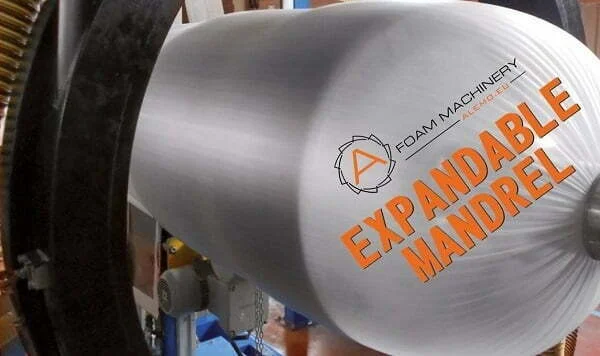
Expandable mandrel
Foam sheet extrusion expandable mandrel was developed to considerably reduce time and production costs of foam extrusion by changing the sheet width without stopping the foam extruder or breaking the EPE foam!
The diameter – circumference change is done instantly by simple manual regulation of expansion, no electric mechanism inside.
The expandable mandrels of different ranges are air-cooled and suitable for extrusion of thin low density epe foam sheets.
100% Better Compression EPE foam of 0,02in Thickness by ALEMO Extruder EXT130
ALEMO Foam sheet Extrusion line EXT130 with capacity 1300 lb/h (600 kg/h) is able to produce 126” Width and 100% Better Compression EPE foam of 0,02” Thickness at 0,0022 lb/ft2 Density for packaging purpose in comparison to Standard EPE foam of 0,04” Thickness at 0,0033 lb/ft2 Density.
This is ALEMO Foam Machinery.


Can you see the difference?
We are pleased to show you the latest foam sample made from ALEMO’s extruder with the goal to produce a recyclable phisically foamed polyethylene foam (EPE) with similar properties to a non-recyclable chemically cross-linked polyethylene foam (XPE).
The photo is showing a comparison between recyclable EPE foam sample and non-recyclable XPE foam sample.
Recyclable EPE foam with stronger and more durable cell structure is supposed to replace an important part of XPE foam market in the future. Final customers are focussing more and more on the circular economy and thus toward development of sustainable foam products. Last but not least, the production costs of EPE foam are lower compared to XPE foam.


Sustainability
The path to the circular economy
The production of polyethylene and polypropylene foam is becoming increasingly challenging as companies strive to reduce their carbon footprint and meet new environmental standards. The process of producing stable, high-quality foam is already very demanding when using virgin raw materials, and the reuse of recycled plastic poses a real challenge.
The new goal is not only to develop technology capable of reusing 100% of recycled foam (material sourced from foam processing companies) in new products, but also to be able to reuse post-consumer recycled plastic (PCR). PCR is reprocessed plastic derived from household or commercial waste, most of which was previously used for packaging. PCR contains higher levels of contaminants that must be filtered out to achieve good foaming results. To meet this challenge, improved mixing technology and continuous melt filtration must be applied to ensure a stable and reliable foam extrusion process. All these higher rates of contaminant removal and maintaining melt flow indices at stable levels require improved mixing screw design and a better filtration process without compromising cost-effectiveness, productivity, quality, and product safety.


ALEMO’s Research and Development department has been addressing the challenges of the circular economy for over a year and has already demonstrated excellent results with foams produced on ALEMO extruders containing up to 15% PCR.
Even better results are expected with new PCR material compounds blended with virgin material to create compounds with PCR levels of up to 80%, as recently launched by some polymer raw material suppliers. These more stable compounds with improved processability can increase the percentage of PCR content incorporated into a given application and expand its range. These compounds offer potentially significant reductions in carbon footprint of up to 25% and energy consumption of up to 30% compared to virgin material.
Foam manufacturers will compete in an environment marked by rising raw material prices, higher energy costs, and increasingly stringent environmental regulations. This ongoing pressure on companies to reduce their environmental footprint is also driving technological development. Improved technology is the only way to meet environmental standards and further reduce production costs.
In the near future, it will not be enough simply to reuse a certain percentage of foam recycled in-house. The foam industry, too, will need to transition to a circular business model, maintaining its value through the recycling and reuse of materials, with benefits that come at no cost to the planet.


